
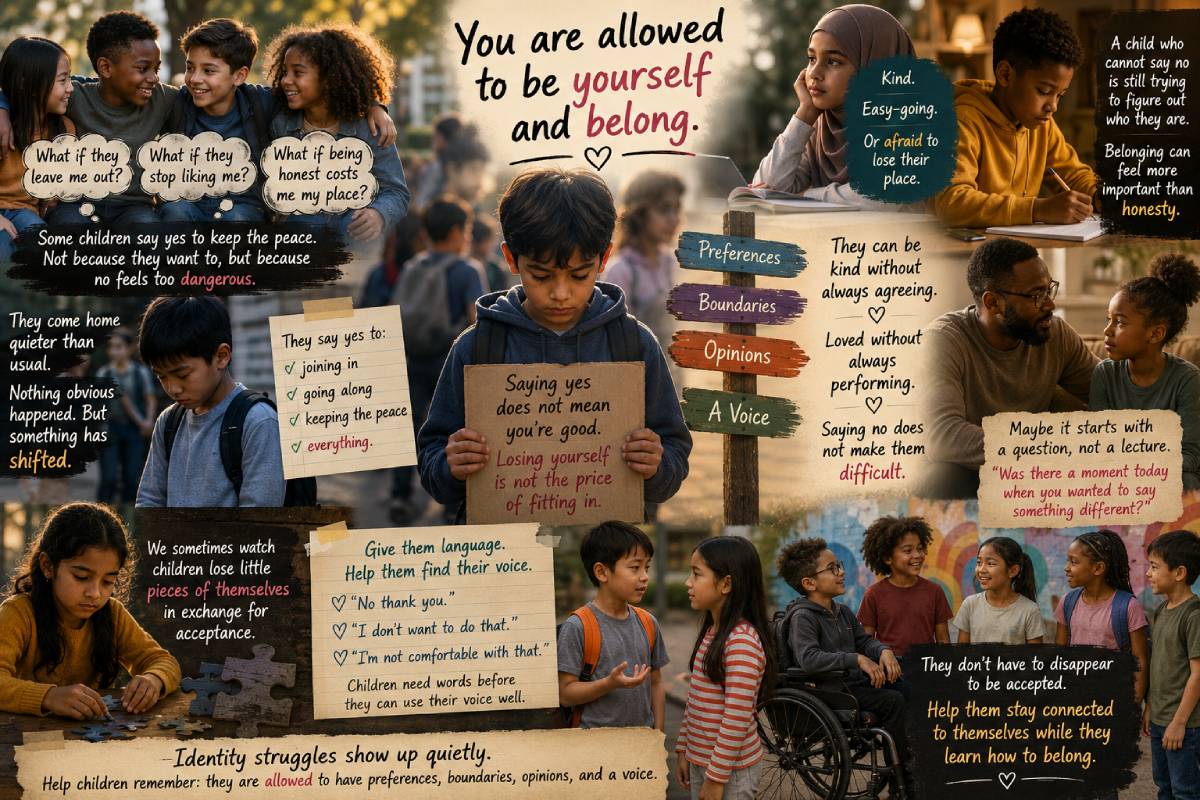
Have you ever watched your child say “yes” to something they clearly didn’t want to do….. just so they could keep a friend?
I keep thinking about the child who says yes before they’ve even checked how they really feel.
This used to be from childhood and even in my adulthood years. Only difference now is me being more aware and managing my strengths and weaknesses better with insight and intentionality.
This child I am talking about says yes to literally everything! Let’s deep dive a little…..
Yes to joining in.
Yes to going along.
Yes to keeping the peace.
Then they come home quieter than usual.
Nothing dramatic has happened. At least, nothing obvious. But something has shifted. You can feel it in the way they drop their bag, the way they avoid your eyes, the way they answer, “It’s fine,” a little too quickly.
Some children say yes because they are kind. This is my son, generally though he’ss now a teenager, which means his identity has been formed a long way, and still evolving.
Well, some say yes because they are easy-going.
And some say yes because saying no feels too dangerous. This is the issue right here as I feel they are not personally aware enough to say to literally everything because no feels dangerous or the FOMO (Fear of missing out).
Not dangerous in a dramatic way.
Dangerous in the small but powerful way children understand so well:
What if they leave me out next time?
What if they stop liking me?
What if being honest costs me my place?
That is the part adults can miss or often misunderstand.
We often notice the behaviour, but not the weight behind it.
A child who cannot say no is not always struggling with manners or confidence in the way we imagine. Sometimes they are still trying to work out who they are, and belonging has started to feel more important than honesty.
So, they bend.
They adjust.
They become easy to carry along.
Not because they are weak, but because they have not yet learned that their voices can survive someone else’s disappointment.
I think this is one of the quieter ways identity struggles show up in children.
Not in rebellion.
Not in big speeches.
But in the slow habit of disappearing into what everyone else wants.
And if we are not careful, we can mistake that for being “good”.
A good child.
A polite child.
A child who does not cause trouble…. this was always me. The conformist as I always tried to fit into everyone’s ideology of me and meet their expectations. As a child I forgot who I really was or shall I say I unknowingly buried who I was for some time.
The truth is we sometimes unknowingly watch or allow a child lose little pieces of themselves in exchange for acceptance.
That is why identity matters so much.
Not because children need big words about purpose before they are ready. But because they need to know, in simple ways, that they are allowed to have preferences.
Boundaries. Opinions. A voice.
That they can be kind without always agreeing.
That they can be loved without always performing.
That saying no does not make them difficult.
Maybe that work starts with something small.
Not a lecture.
Just a question.
Was there a moment today when you wanted to say something different?
Or maybe it starts with giving them language they can borrow until it becomes their own:
“No thank you.”
“I don’t want to do that.”
“I’m not comfortable with that.”
Children need words before they can use their voice well.
And perhaps that is part of the deeper work for adults too. This is not just teaching children how to behave, but helping them stay connected to themselves while they learn how to belong.
Because the child who always says yes may not simply need to be bolder.
They may need help remembering that they do not have to disappear to be accepted.